Nancy Mace introduces resolution to expel Cory Mills from the House
The Ghost of Federalist No. X
Of Expulsion and the Degradation of Constitutional Machinery: A Meditation on the Mace-Mills Affair
I. The Present Malfunction
In the year of our Lord 2025, the United States House of Representatives—that "grand depository of the democratic principle," as the Federalists conceived it—witnesses yet another grotesque exhibition of its mechanical failure. Representative Nancy Mace of South Carolina has introduced a resolution to expel Representative Cory Mills of Florida from the legislative body, not for treason, not for bribery, not for any high crime enumerated in the careful architecture of our constitutional order, but for what appears to be a personal vendetta dressed in the borrowed robes of institutional propriety.
The expulsion mechanism, enshrined in Article I, Section 5 of the Constitution, was designed by men who understood human nature with crystalline clarity. They knew that legislative bodies would occasionally harbor members so corrupt, so treasonous, or so derelict in their sacred duty that removal became necessary for the preservation of republican government itself. It was to be the legislative equivalent of amputation—a grave measure, requiring a two-thirds majority, reserved for instances where the body politic faced genuine sepsis.
What we observe now is the deployment of this constitutional scalpel as a butter knife in a cafeteria squabble.
II. The Natural Law Foundation and Its Corruption
Madison, Hamilton, and Jay constructed their "machine of state" upon principles derived from Natural Law—that body of moral reasoning accessible to human intellect through observation of nature and the exercise of rational faculty. The Federalist Papers, particularly Numbers 10, 51, and 62, articulate a vision of government that channels human ambition and faction through institutional structures designed to prevent any single passion from overwhelming the whole.
The expulsion power was one such channel—a pressure valve, if you will, calibrated to release only when internal corruption threatened the integrity of the entire apparatus. Hamilton, in Federalist No. 65, writing on the related impeachment power, observed that such proceedings would "seldom fail to agitate the passions of the whole community" and would inevitably "divide it into parties more or less friendly or inimical to the accused."
Here we witness Hamilton's prophecy fulfilled in its most debased form. The expulsion mechanism, intended to remove those who betrayed the constitutional order, has itself become an instrument of factional warfare. The machine's governors are spinning wildly, disconnected from the load they were meant to regulate.
III. The Calibration Error
Where precisely has the calibration failed?
First, in the degradation of institutional memory. Only twenty members of the House of Representatives have been expelled in the entire history of the Republic—seventeen of them during the Civil War for supporting the Confederacy, and three for criminal corruption so brazen it admitted no defense. The threshold was intentionally set at supermajority to ensure that expulsion would be rare, solemn, and reserved for offenses that genuinely threatened the constitutional order.
Representative Mace's resolution—whatever its specific allegations against Mills—represents a normalization of the extraordinary. When the nuclear option becomes conventional, the reactor core is already in meltdown.
Second, in the substitution of performance for governance. The Founders understood, as Publius wrote in Federalist No. 10, that "enlightened statesmen will not always be at the helm." They designed the system to function even under mediocre leadership. What they could not have anticipated was leadership that would mistake theatrical gesture for statesmanship, that would trade the sober exercise of constitutional powers for viral moments and fundraising appeals.
Third, in the collapse of deliberative norms. The House was designed as the "people's chamber," yes, but the people filtered through representatives who would, as Madison hoped, "refine and enlarge the public views." The expulsion power assumes a body capable of deliberation, of weighing evidence, of subordinating passion to judgment. When that capacity atrophies, constitutional mechanisms become weapons in a war of all against all.
IV. The Deist's Lament
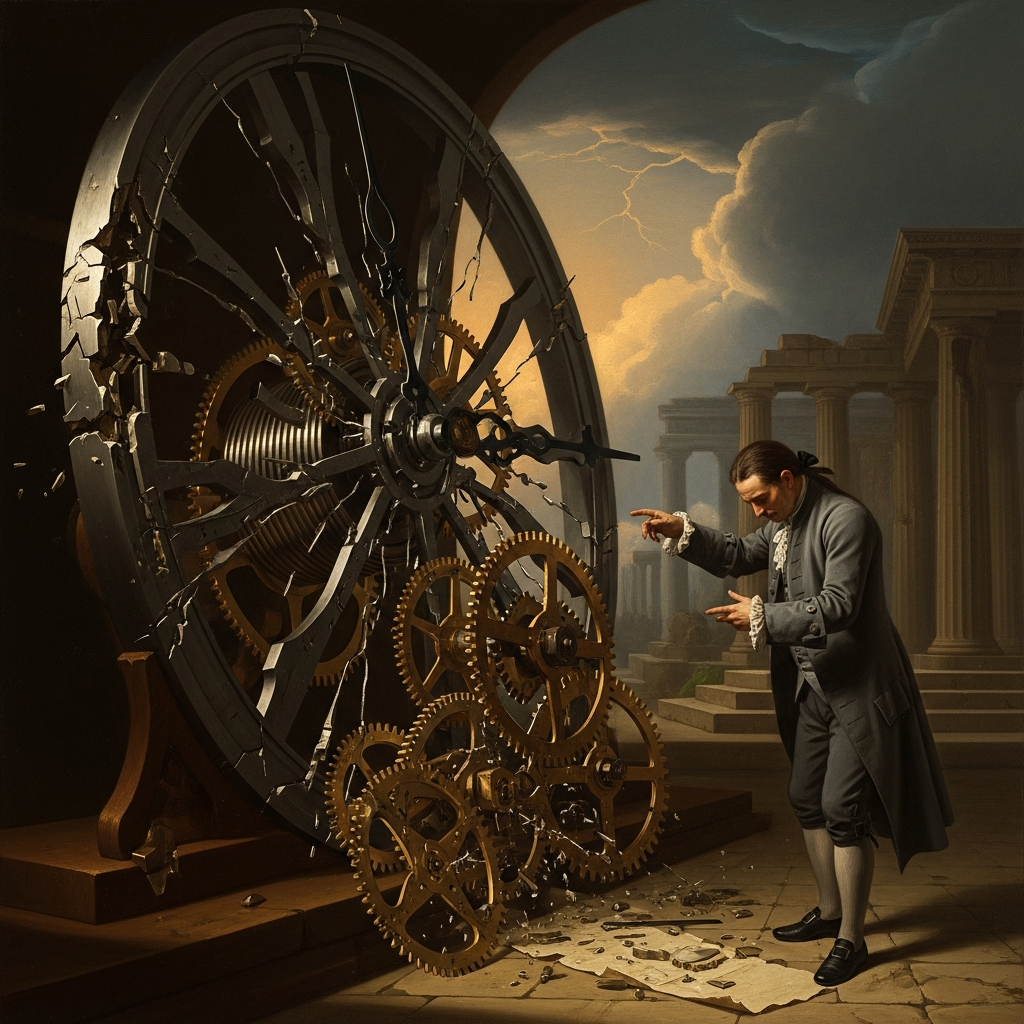
From the vantage point of the Clockmaker's Workshop, one observes with detached despair the spectacle of a finely crafted mechanism tearing itself apart through misuse. The Deist conception of government—as a rational ordering of natural principles, designed to operate with minimal divine intervention once properly constructed—assumed operators who understood the machinery they inherited.
What we witness now is the equivalent of children playing with grandfather's pocket watch, fascinated by the immediate result of pulling springs and dislodging gears, entirely ignorant of the precision engineering required to make the whole function.
The Natural Law principles that undergird the Constitution are not obscure. They are accessible to reason, inscribed in the nature of things. A legislative body that expels members for political convenience rather than genuine unfitness destroys its own credibility as a deliberative institution. A faction that weaponizes constitutional mechanisms for tactical advantage ensures those mechanisms will be deployed against them in turn, ratcheting toward chaos.
This is not prophecy but mechanics—action and reaction, cause and effect, as predictable as a falling body or a swinging pendulum.
V. The Question of Intent
One must ask: Does Representative Mace genuinely believe that Representative Mills presents such a threat to the constitutional order that his removal by two-thirds vote is warranted? Or is this resolution theater—a gesture designed to signal commitment to a particular faction, to raise one's profile, to demonstrate "fighting" irrespective of outcome or institutional cost?
The Founders would have recognized this as precisely the species of factional manipulation they sought to prevent. Federalist No. 10's famous analysis of faction defines it as a group "united and actuated by some common impulse of passion, or of interest, adverse to the rights of other citizens, or to the permanent and aggregate interests of the community."
If this resolution serves partisan interest at the expense of institutional integrity, it is faction in its pure form—the very disease the constitutional machinery was designed to mitigate.
VI. The Broader Mechanical Failure
This incident cannot be isolated from its context. The House of Representatives has, over recent decades, transformed from a deliberative body into a performance space. The expulsion resolution is merely one symptom of systemic degradation:
- The abandonment of regular order, with legislation increasingly crafted in leadership offices rather than through committee deliberation;
- The rise of the permanent campaign, where members spend more time fundraising than legislating;
- The collapse of cross-partisan working relationships, once the lubricant that allowed the machine to function despite disagreement;
- The outsourcing of deliberation to media, where positions are staked out on cable news before being debated on the floor.
Each of these represents a departure from the operating principles encoded in the Federalist vision. Each represents a loss of calibration, a gear slipping out of alignment, a governor disconnected from its shaft.
VII. The Way Back
Is recalibration possible? The Deist maintains a cautious optimism grounded in the durability of Natural Law principles. The machinery can be repaired, but only if operators rediscover the manual—which is to say, the foundational principles that animated the Framers.
This requires:
- Restoration of institutional norms that distinguish the routine from the extraordinary, the procedural from the nuclear;
- Reestablishment of deliberative capacity, including the willingness to engage in good faith with those of opposing views;
- Reconnection of constitutional mechanisms to their original purposes, rather than their repurposing as tactical weapons;
- Recovery of institutional memory that recognizes how rarely and reluctantly extraordinary powers should be deployed.
None of this is esoteric. It requires only what the Founders assumed: reasonable human beings applying rational principles to the problems of self-governance.
VIII. Conclusion: The Clock Winds Down
The resolution to expel Cory Mills will almost certainly fail—the two-thirds threshold remains, for now, a mechanical barrier to purely factional exercises. But the damage is done not in the outcome but in the attempt. Each invocation of extraordinary powers for ordinary disputes recalibrates expectations, normalizes the extreme, and brings us one step closer to a system where all disagreement is treated as existential threat.
The Founders gave us a machine designed to operate across generations, to channel human ambition and faction into productive competition rather than destructive warfare. But machines require maintenance, and operators who understand their function.
From the Workshop, one observes the springs uncoiling, the gears grinding, the pendulum's swing growing erratic. The clock still runs, but it no longer keeps time. And a timepiece that cannot tell time, however beautifully crafted, is merely an ornament—a relic of a more rational age, admired but no longer trusted, consulted but no longer believed.
The question is not whether Nancy Mace's resolution is justified—that is a matter for the House to determine through its constitutional processes. The question is whether the House retains the institutional capacity to make such determinations rationally, or whether it has devolved into a theater where constitutional mechanisms are props in performances designed for audiences far from the chamber floor.
The Deist, observing the machinery, fears the answer is already evident in the grinding of the gears.
From the Clockmaker's Workshop, where springs unwind and pendulums still swing—though with increasing irregularity—this meditation is offered to those who retain ears to hear the grinding of constitutional machinery run amok.